Before we wrap up the last leg of this journey, I wish to thank you, my loyal fans. Without you, there is no journey. This was the primary reason I wanted to share this particular story. If you read Cataclysm, I intentionally left you with a sense of reflection, specifically for the character known as the Executive. We learned he was trying to save the world. He always seems to know something we don't and stays several steps ahead of everyone else. (This will come in handy later in the series.) To fall in love with a character (good or bad), we need to get to know him/her intimately. We must witness their strengths as well as their flaws.
In "Find of a Lifetime," we delve into the Executive's past by climbing his family tree, where we can see how this multigenerational quest to save the world began. In the end, you will see something else about the unshakeable billionaire. He carries not only physical scars but, hidden deep beneath his seemingly impenetrable façade, somewhere in the far reaches of his psyche, a daunted man. We really want to see him succeed, but it leaves us wondering if the guy is strong enough to carry us over the finish line and bring an end to the Apocalypse.
Get your popcorn ready! Here is the third and final part of "Find of a Lifetime."
*****
1933: Cairo, Egypt
Once inside the Repository, both men stood gawking in reverence at the massive chamber. A pinkish-red glow emanated from giant twin stone pillars that disappeared into the darkness well above them.
It was lunacy how the structure somehow defied physics.
And when the world heard that Plodington and Monroe had discovered the strange structure, oh, the rewards they would surely reap! Monroe wiped the tears from his face. It was time to serious up.
“I’d ask who built this,” Plodington started, “but I believe a power far greater than humans had something to do with it.”
Monroe nodded.
They stood upon a gold path that began at the Holy Seal and ended at a marble border surrounding the darkest onyx they had ever laid eyes upon. Was it a void? Cautiously, they tread on the onyx circle. Twin pillars stood on either side of the circle. A wide stone podium, with a scroll lying open, sat at the heart of the circle. A pair of sconces, neither of which they had noticed, burst to life with a startling whoomph as the two approached the podium. They glanced at one another, chalking this up as another enigma. The sconces' flames let them read the parchment, which bore the same sigils found along the structure’s walls.
They stepped up to the unrolled parchment without touching it. As with the wall glyphs, they focused on each symbol and heard the words read in their minds, in their own voices. They quickly learned this was no ordinary document. The ink was not mere ink: it was the blood of Jesus Christ gathered at the Crucifixion by Lucifer. And the parchment was no ordinary document: it was a contract made by Jesus and Lucifer—a pact between Heaven and Hell.
“Mankind had failed their Maker and His Son,” Plodington repeated the words deliberately.
“The bloody pact is called a Test of Mettle,” Monroe murmured. “And these scrolls”—they both peered at the shelving units around the onyx circle—“are records of those tests.”
Monroe gathered himself. “I read about these tests in the antechamber,” he said. “Lucifer tests us with his hellspawn nightly, at 11:34.”
Plodington nodded. “We are neck-deep in this Test of Mettle, which leads to the Apocalypse, and no one is the wiser.”
A long, quiet moment hung heavily between them.
Monroe broke the silence. “Crap.”
“Yeah,” Plodington said softly. “Crap.”
“So, what do you think, Duke? I say we investigate those scrolls to see what all this Test of Mettle business is about.”
“I agree.” Plodington rubbed his face. He let their plight sink in for a moment. “However, we must learn more before we can share this with anyone.”
“You mean if we share it with anyone,” Monroe corrected.
Plodington gave Monroe a look that did not require further explanation. There was no conceivable way they could share this with anyone. Their careers were already sliding into obscurity. With their arses on the line, presenting this to the archaeological community would be inconceivable.
They began unrolling scroll after scroll, hearing a Test of Mettle read to them as their eyes followed the glyphs. Each test shared a story about a person or persons who were good or bad, fortunate or unfortunate, young or old. Each tale included graphic details leading up to when one or more demons appeared, always at 11:34 at night. Some demons were small, chaotic, and acted for shorter bursts. Lucifer preferred his chaos demons to his vastly more powerful lieutenants. Chaos demons had a penchant for causing damage beyond mere physical destruction.
Sometimes an encounter required a more savage touch, and Lucifer would employ a more versatile minion for the job. Lucifer demanded his higher-ranking demons use their wits and craftiness over brawn. It was simple logic. The Test of Mettle followed strict rules, and one of them forbade demons from outright killing people. Thus, whenever Lucifer’s minions won their Tests of Mettle, they won the souls of the humans they vanquished. The moody Lord of Hell did not appreciate his demonic elite returning to Hell empty-handed.
*****
Plodington and Monroe eventually went back outside to join the rest of the team, much to the delight of Omar. They had much to discuss, but the Repository's significance left them in quiet contemplation. It was no ordinary structure, and their time was limited. According to the glyphs, the Repository was an immortal being. When it felt it was time, it would move on, go somewhere else in the world, and shift into something that allowed it to blend into its environment.
The world had embraced Howard Carter for his discovery of the resting place of King Tutankhamun, boy pharaoh, son of Amenhotep IV. Their friend had found fame, and his work would endure for decades in dusty old history books clogging library shelves worldwide.
Damien Plodington and James Monroe had discovered something vastly more significant, transcending archaeology and history. Their discovery carried nightmarish, biblical implications. The glyphs spoke of the Apocalypse happening a thousand years after a senior member of the Vatican violated the Repository. A few centuries had already passed. Yet, in all their years and all their travels, neither Plodington nor Monroe had ever heard of anything suggesting the Apocalypse.
Others might have already found the Repository in the past few hundred years. It left the archeologists to wonder if anyone in the world had any knowledge of the event. Surely something of this magnitude would have drummed up some attention. Yet it had not. No bedtime stories hinted at the End of Times. No rumors. Nothing in their years of research. The dirt, it would seem, had quietly found its way under an unassuming rug.
Revealing the Repository or the pact between Heaven and Hell or the hundreds of Tests of Mettle would not only make Plodington and Monroe a laughingstock—it would open up Pandora’s Box. While the archaeological community strengthened daily, it remained fragile during its modest growth. It might not withstand backlash against two of its respected members. The idea of supernatural pyramids, indeed! They could hear the jeers: Those boys boiled their brains in the desert sun. That they would suffer only unemployment and relentless taunting was itself a laughable notion. This was the 1930s, after all. Spouting off rubbish of this magnitude might earn them a one-way ticket into an asylum. There, they would be treated as laboratory playthings until they were left circling their padded cells, dragging their feet, little more than drooling zombies. As outcasts, they would be forgotten, and their discovery would mean nothing.
Plodington and Monroe would have plenty of time to plan if and how to reveal their find to the world. First, however, they needed to get to work right away, because their time with the immortal being was not limitless. The angelic scribe might stick around for only a month, or a week, or even just a few hours. They had no way of knowing. Whatever time they had left, it was their responsibility to spend it wisely—to spend every moment studying this most crucial discovery. The archaeologists confronted Omar and the small band of workers, warning them of the consequences of sharing supernatural fables. The team required little convincing. While the workers were compensated for their hard work, deities, curses, and the unexplainable made them skittish. For them, this was just a job that put food on their tables, and they wanted to keep it that way.
*****
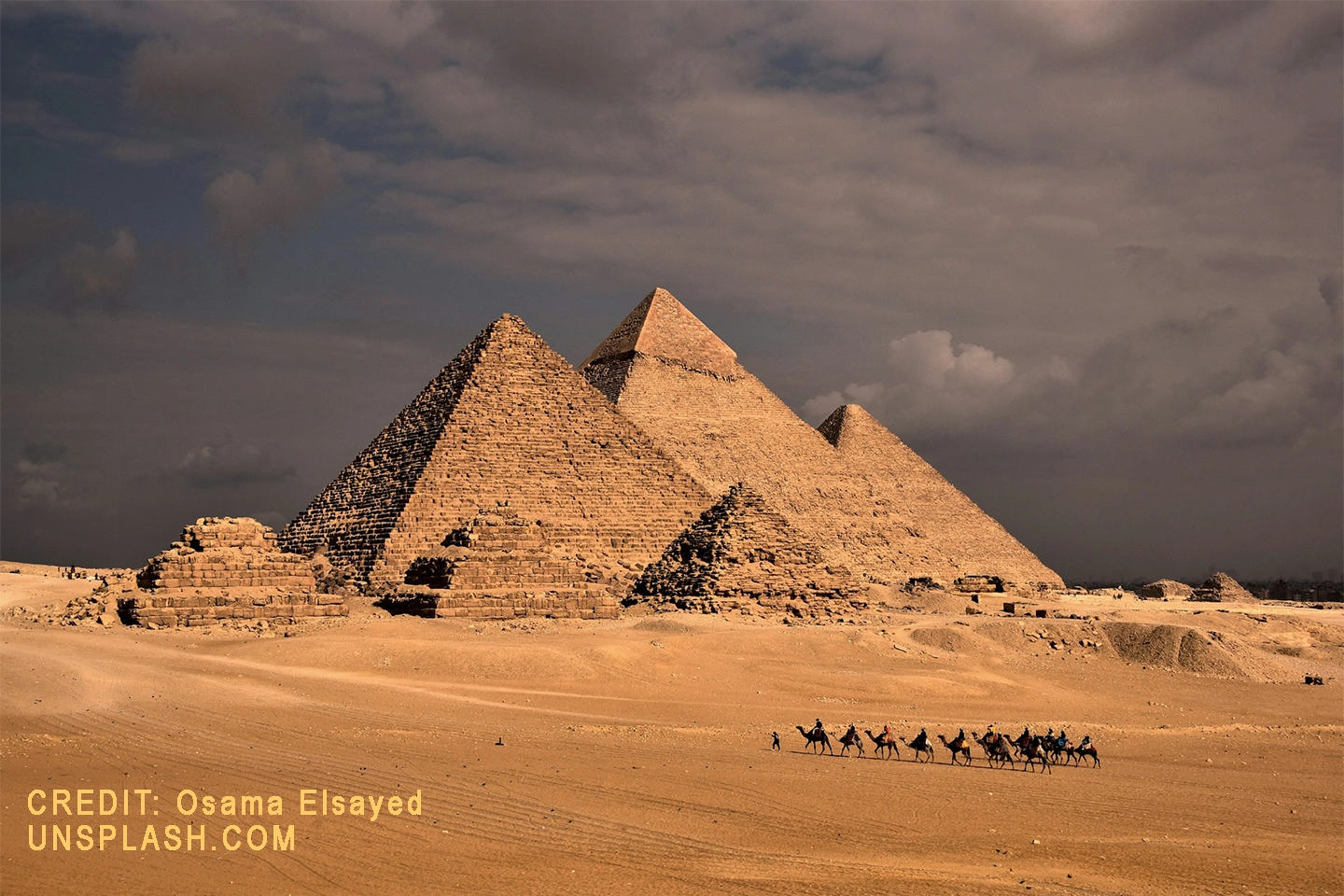
There was no mark left in the desert when the upside-down pyramid suddenly vanished. No blemishes or gaping holes, no cosmic concussions or colossal supernovas. The pyramid was there one second and gone the next. The desert heat intensified as they all stood on baking sand. The disappearing act only heightened the workers' anxiety. As the team slid down the dune toward the caravan, a wave of anguish struck Plodington and Monroe, who lingered behind. They would never receive that second opportunity. The pyramid was a sign. It had communicated many things to them—the Apocalypse, by far the most important. They could not ignore its significance, which left them stuck in a serious dilemma. It would be irresponsible to remain silent on the matter and just as impossible to speak a word of it. An idea bloomed at that moment. Alone at the top of that scorching dune, they discussed their next move.
*****
After seeing their scheme through to completion, which was all that mattered in the end, Doctor Damien Plodington and Doctor James Monroe returned to perform without protest the lackluster tasks demanded of them. Plenty of unknowns lay down the road, with unforeseen obstacles to hurdle. The Apocalypse had hooked its talons into the world. It would take a while to free mankind—perhaps several generations—but the two had done their part. Someone else would need to step up and do theirs.
Sure, Damien Plodington and James Monroe never made a single headline and cannot be found in the dusty pages of any history book. Though they left the world old, worn, and penniless, they found peace because they had accomplished something far more gratifying than fame and fortune. They had helped save the world thanks to their chance encounter in Cairo. And who could fault them for feeling a little smug? Locating the Repository was their find of a lifetime.
*****
After instructing his secretary not to disturb him during his time of reflection, the Executive rose from his desk, hobbled over to the fireplace in his office, and leaned his cane against the fireplace. Dozens of pictures graced the mantle, and his eyes danced along from one to the next until they fixated on a faded black-and-white photograph. He lifted the framed photo with utmost care and studied the three well-dressed men in the picture. His eyes shifted to the bottom-right corner where a date was handwritten: 25 Dec 1933. His eyes returned to the three men. Despite the aged visage of a black-and-white photo, he could easily pick out the leathery appearances of Doctors Damian Plodington and James Monroe. Each held a cigar and a snifter of brandy.
Between the archaeologists stood a man the Executive knew all too well. He never met the man; too many years separated them. The man in the middle died long before he was born; he was his great-grandfather. Despite being generations apart, they shared a mutual objective: save the world from the Apocalypse.
The Executive was the fourth generation to tackle the Apocalypse. The previous three generations had done their part by building and maintaining financial empires, leaving him billions of dollars in capital—equity—at his disposal. It was his turn now. His task differed from theirs. His mission was to quell the Apocalypse by every means necessary. If he could not complete the job, then he needed to pass the torch to his son.
What had he accomplished? What would his forefathers think? The Executive was getting up there in years. He had not married and conceived no children. While he found evidence of the Repository as his great-grandfather had, he had moved no further ahead in the game than where his great-grandfather had left off. Philadelphia had nearly claimed his life, but it took so much more.
His foot lashed out at the cane, missing it altogether. The Executive grappled at the mantle after nearly losing his balance. Was he strong enough to carry out such a herculean burden?
The granite features chiseled into his normally stoic appearance crumbled. His forehead fell onto his arm, jolting the picture from his quavering grip. A tear ran down his cheek.