Here is a fun little FAQ related to writing.
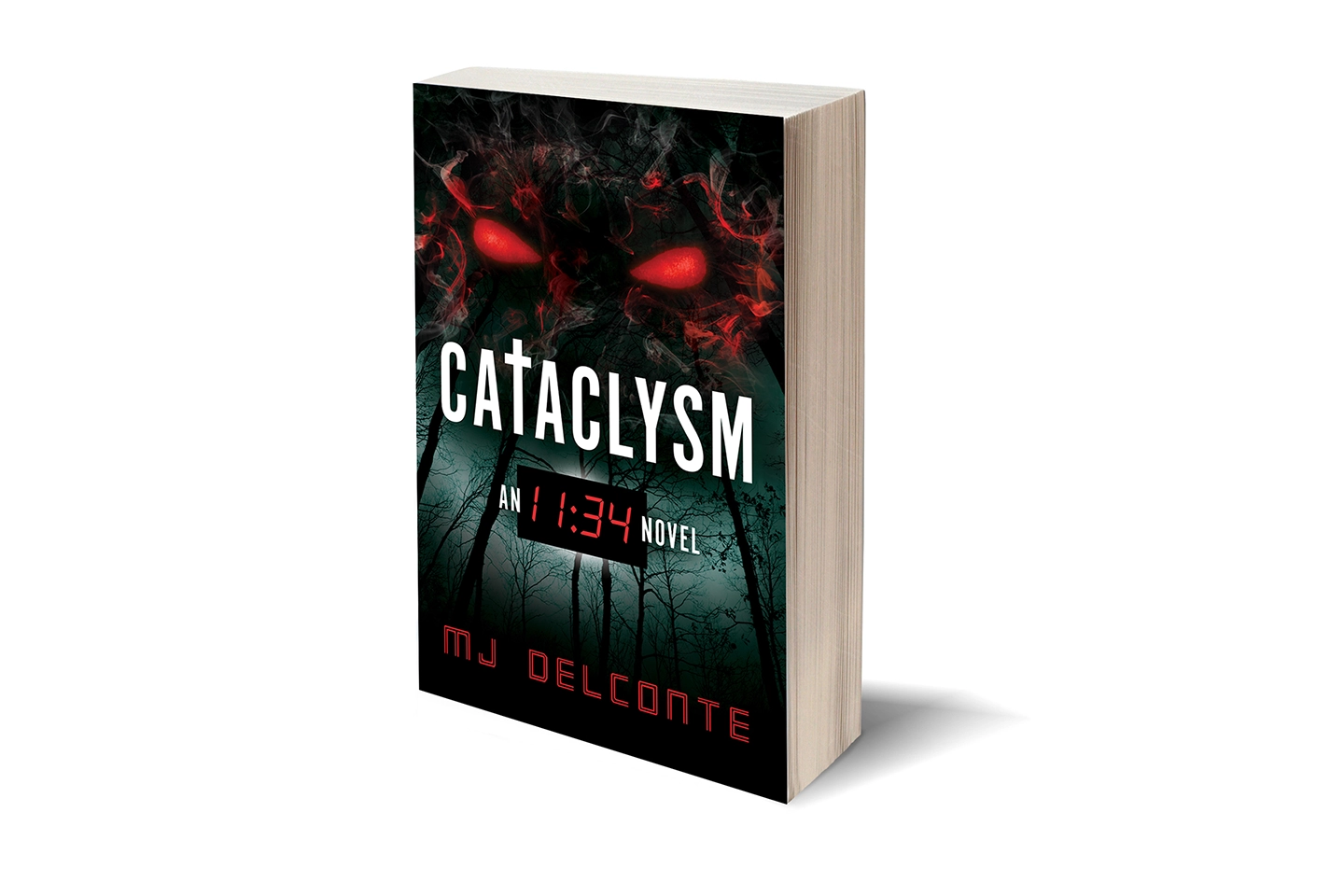
Q: What inspired you to write Cataclysm, the first novel of your 11:34 series?
A: A nightmare. Nightmares are a keyhole into the psyche. They find the chink in our armor and exploit it. For that, I guess I am weird because I love nightmares. I woke at two in the morning after that one fateful nightmare and found myself writing about it on my home office’s dry-erase board until five in the morning. I just couldn’t let it go. Something in me had erupted like a volcano, and there was no way I was getting back to sleep until I wrote it down. What I wrote became the foundation of the 11:34 series.
Interestingly enough, around that time I was desperate for an artistic outlet. I worked for lousy management at a university, which drove me to find something to keep me from driving myself crazy. Writing a novel has been a lifelong aspiration of mine since I was a child. Everything just kind of clicked that night.
Q: Do you normally have nightmares or ones that drive creativity?
A: I rarely have nightmares. When I do, I will write them down, but only if they are solid. Dreams, good or bad, have a knack of leaving an impression. Others are just dumb and a waste of time.
Q: Do you like to sleep?
A: No. Not at all. Until I experienced my serious illness last year, I was used to getting by on four hours of sleep a night. I felt like sleep was getting in the way of progress. I preferred spending time writing, learning, reading, or studying to sleeping. Post-illness, I now find myself sleeping at least six hours every night plus naps whenever my body calls for it.
Q: It has been years. Why is it taking so long to publish your novel?
A: The nightmare that became the foundation of 11:34 occurred fifteen years ago. Like any idea, I needed time to mold the dream into something tangible, and over a year or two, it became a living, breathing three-dimensional beast. It had legs to stand on. That’s when I was truly sold on writing a novel. So, I researched the hell out of the art of writing and the dream itself.
Q: What did you do to prepare yourself to write Cataclysm?
A: No matter how good or bad you feel you are as a writer, what you will hear over and over and over again is that you must write. And keep writing. If you want to succeed, then you might need to do the things successful writers do. Some go to school and earn fancy degrees, like MFAs. Others grow tired of the career they spent cultivating and leave their jobs as attorneys, politicians, or whatever to become authors. Me? I spent the past thirty-plus years working in technology. One day, I hope authoring will become my next career.
No matter how you arrive at the point in your life when you decide you want to be a writer or author, it would be in your best interest if you improve your skill set. I read several books on the subject. I used YouTube, Amazon, or any resource that let me stream and listen to authors’ stories. Multiple sources insisted that you needed to write a million words. You can’t play pro sports without going moving up the ranks and practice, practice, practice.
I wrote my first novel, Deathsword. It's 360 pages and has been rewritten eleven times. After that, I spent six months honing my writing skills at Gotham Writer’s Workshop in New York. I practiced the craft, entered numerous writing contests, participated in writing prompts, and did whatever I could to try something new and different to expand my artistic horizons. Then, I revisited Deathsword. It remained a good story, but the writing was awful. So I wrote several short stories; I submitted some to magazine writing contests. None earned any awards, but I found my writing was improving. I put Deathsword aside for another day and began writing the Test of Mettle stories for 11:34. Cataclysm had more traction once it had some meat on its bones. I found myself outlining the series and writing for the second and third novels.
After three rewrites—the third I completed after my long illness this year—Cataclysm was ready.
Q: What steps have you taken after the book was written?
A: Before I can answer that, we need to look at 2019. I thought the novel was ready after the second major rewrite. I was sorely mistaken. I peddled the novel to forty-one agents. Only twelve responded. Nobody was interested. I started to think my novel wasn't ready, and wondered what I could do to change that. I did some additional research and contacted a company called Write by Night in New York. I paid them to have my novel professionally critiqued. It was precisely what the novel needed at that time. While the writing was pretty strong, it still had mistakes. I cleaned them all up with the third rewrite.
After the third rewrite, what should my next step be? The manuscript is good, but is it ready for publication? I don’t know. The only way to find out is to reach out to more agents. So I did: twenty agents and twenty publishers, but not until the query letter, bio, synopsis, pitch letter, marketing plan—all of it—is in perfect condition. This also includes professional proofreading and editing. Some publishers will not accept your manuscript unless it has been sanitized.
Q: It sounds like you have a game plan. Would that be an accurate assumption?
A: Absolutely, and I am following my game plan to the letter. If the brick-and-mortar route fails, then I will e-publish the book. By then, the book will be ready, cleaned, and free of mistakes.
Q: You’ve brought that up a few times. What’s your position on having your manuscript professionally proofread and edited?
A: Let’s say you spend a lot of money on groceries to make a meal for a large group of people, but you choose not to follow a recipe. You just kind of wing it. The end product is okay, but its flaws keep you from truly enjoying what could have been something great. That’s writing in a nutshell. Why spend hundreds of hours researching and writing something you are passionate about only to watch it flop because you chose not to polish the end result? It’s a travesty. It’s something you see nowadays. Nothing is more discouraging than finding a story that captures your interest, only to find the reviews padded with comments about syntax, grammar, and spelling.
I've come across a few novels that weren't proofread or edited, and the mistakes were so distracting they made them impossible to finish. I stopped reading one such e-book after only a few chapters because of the constant errors. I could not get through them; they killed the story for me.
Now, before I buy an e-book, I take time to skim the reader’s comments to see whether there is a pattern of complaints about grammar, misspellings, and syntax. That's unfortunate, but necessary these days. How many novels written by James Patterson, Stephen King, John Grisham, or any of the other great, successful authors out there have published books loaded with syntax, grammar, and spelling errors? It is probably nonexistent, right? So, my advice is to do what the greats do. Have someone spit-shine your work to make it glow!
Q: Can you give us a glimpse into your novel-writing crystal ball? What do you have planned?
A: If my novels do not draw attention, then what is the point of writing them? Success also, let's be real, requires a modicum of luck. If that happens, I am reaching for the stars. I would love to revisit the Deathsword project. Deathsword was planned to be a three-book epic. I have a few other ideas in the works. Time will tell.
Q: Has working in technology helped you with your writing endeavor?
A: In some ways, yes. I wrote hundreds of technical documents over the years. I’ve also written thousands, if not millions, of lines of code (web pages, scripts, etc.). Writing a story is a bit like writing a program. You have to write it in a particular order, or you risk breaking the story's flow if part of it is out of sequence. If your syntax is incorrect or your code contains spelling errors, it will not work. And nobody wants that.
It’s rare to come across an IT guy or gal who left their career to become an author. You see it more often among lawyers. I’d like to be that IT guy who finds success.
Q: Since going back to Write by Night, what, if anything, have you learned about the business?
A: It’s not as easy as simply writing a novel. There is way more to the publishing business than I realized. I didn't reach out to publishers last year, so I learned about another side of peddling your manuscript and how to write your query letter. Last year, I used what they call a “shotgun approach,” sending my query letter to agent after agent. Mind you, I vetted each one, but I failed to explain why they mattered and why they would make an ideal agent. If they published a rash of thrillers, then it would have been wise to list these in the query letter. You have to tailor your query letter to each entity it is being sent to, so include a few lines that rope them in and make them feel included.
It’s useful for new writers to invest time in educating themselves a little about the business. I researched this long ago, and GWW provided some insight as part of their program, so I wasn't completely in the dark.
It may explain why authors choose to saturate the market with error-laden e-books. Maybe they don’t want to go through the hassle and expense. I feel this is the lazy way out, but in the end, it is their creation, so it is their decision. Going down this rabbit hole will negatively impact sales. Another tip for new novel writers: prepare yourself for this.
Q: What else can you tell us about Cataclysm?
A: Well, as I mentioned, the manuscript is in the hands of Write by Night. It's being professionally proofread and edited. It will take time; this is not a process you want to rush. In the meantime, the other components for peddling novels—bio, pitch letter, synopsis—need to be perfected. I’ve written several versions of these, but it is good to have another set of eyes on them. Write by Night is also making sure these are ready to go. I should have the query letter done soon and will submit that to them for review.
Q: Series are not easy to write. Authors have repeatedly commented about the challenges of maintaining the timeline and knowing every small detail about each of their characters and the events that had taken place. 11:34 is intended to be a series. What is your experience with this?
A: No doubt, this will be a challenge. Not only do I have to contend with timelines, but my series is a set of short stories spanning 400 years, since the initiation of the Test of Mettle. I cannot possibly have a single protagonist who stands out because no one lives that long. Ergo, I felt it necessary to create several short stories to tie everything together.
The series will be at least three books long, and I’ve been considering a fourth novel. I wrote out the timeline on a twelve-foot strip of banner paper and pinned it to my wall. It came tumbling down one breezy day, so I need another solution to track everything that happens. I also need to pay attention to the small details around the Tests of Mettle because they become significant later in the series.
Q: What can you tell us about the second novel in the series?
A: Technology, the internet, society as a whole… they all play against the Executive, whose organization is feverishly working to locate the Repository, an angelic being who can transform itself into any structure anyplace at any time. When the Final Sin was committed 400 years ago, commencing the Test of Mettle, the Repository was there. And the Executive knows this. But so does someone else, and they wish to see the Apocalypse through. The Executive is keen to find the elusive Repository, which has been located only three times in the past 400 years. The tests ratchet up several notches when a former military hero, known as The Doer, is thrust into action and locates the Repository in the process. The Doer now becomes the only human on the planet with the knowledge to end the Apocalypse. Except, Lucifer is watching, waiting, and seething. Lucifer decides to enact the Test of Mettle on the Doer that very evening, at 11:34. Lucifer selects a very special demon to perform the Test of Mettle: himself. If the Doer wins, then he can never be tested again, and the information he carries gives humanity a considerable advantage. If the Doer loses, the information is forever lost, and Lucifer will claim the Doer’s soul. It will be an epic showdown.
When time permits, I am working on completing the second novel. I would like to have the first draft finished by the end of the year.
Q: You created a trailer for the first novel and hinted at a second trailer. Can you share anything with us?
A: I intend to produce a bigger, badder video. It’s too early to share details, but I envision something that captures the spirit of the Test of Mettle between Lucifer and the Doer.